

Issue 518 – Sunday, July 19, 2026
In this issue:
City
Urban forestry: Where have all the trees gone?
School district
Heading to a referendum
Business
Glass Nickel Pizza in Middleton?
City
Urban forestry: Where have all the trees gone?
According to a tree inventory done this year by Bluestem Forestry Consulting for the city of Middleton’s parks and recreation department as part of the ‘Urban Forestry Plan’, the city has 8,802 trees, 1,185 planting sites and 72 stumps. Of these, 913 trees are located in parks and 7,889 trees in streets rights-of-way (trees in the conservancy are not part of the count). The planting sites are all along streets. A total of twenty parks and public spaces were inventoried. The park with the most trees is Lakeview park (181).
The new urban forestry plan recommends removing 399 trees and pruning 199 trees ‘for safety reasons’. About two thirds of all trees are in good or excellent condition, while about a tenth is in poor or very poor health. Thirty five trees are dead.
Middleton’s (non-conservancy) public tree population consists of ‘an astounding’ 112 species. The larger the species variety, the stronger the whole population’s resilience against diseases and pests. Urban forestry standards recommend that no single species should count for more than five percent of the total, and no single genus for more than ten percent. Two species exceed those limits: honeylocust (almost fourteen and a half percent of all trees) and Norway maple (just over eight percent). The maple family of trees makes up almost a fifth of all trees in the inventory. Besides honeylocust and Norway maple, the top ten of most frequent tree species consist of Freeman maple, littleleaf linden, Japanese tree lilac, hackberry, Kentucky coffeetree, swamp white oak, hybrid elm and Redmond linden. They account for just over fifty two percent of all city and park trees. According to Kiley Scherer, the city’s director of parks and recreation, her department will make the complete list of trees and species publicly available via a ‘dashboard’ that is currently being developed.
The document does contain some mistakes and omissions, however. For example, in the list of city parks and trees per park, Baskerville park, among others, is missing, and Orchid Heights park is misnamed Orchard Heights park.
Until the middle of last week, the parks and recreation department’s webpage mentioned that the city of Middleton had 9,167 street trees and 2,210 trees ‘within active park land’, for a total of 11,377 public trees (again, not counting the conservancies). As Kiley Scherer, the city of Middleton’s director of parks and recreation, explains, these numbers reflected the old 2015 inventory, and they have since been updated (see screenshot of updated webpage).
But, comparing the two sets of numbers, it looks like in the last ten or so years the city might have lost 1,278 street trees and 1,297 park trees, for a grand total of 2,575 trees, or almost a quarter of its public urban canopy.
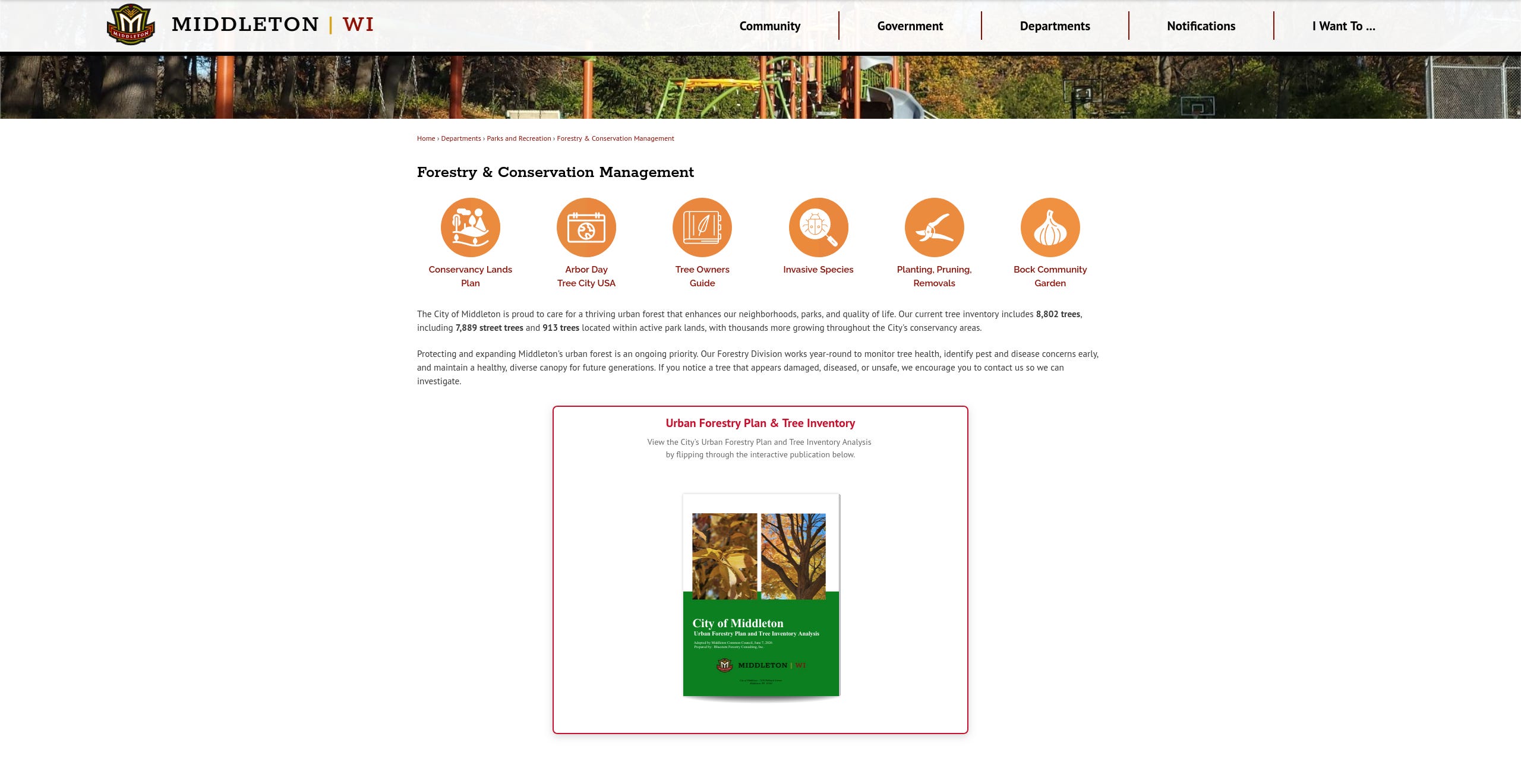
I asked Kiley Scherer about the reasons for the decline, and it seems there was no decline, or at least not to that extent, and the 2015 and 2026 sets of numbers are not really comparable anyway:
‘The previous city-wide tree inventory was completed in 2015. Since that time, portions of the inventory were updated as needed for operational purposes, but a comprehensive city-wide inventory had not been completed again until development of the new Urban Forestry Management Plan.
As part of this effort, the city completed its most comprehensive inventory of publicly managed trees to date. The inventory documented more than 8,000 street and park trees representing 112 different species and, for the first time, provides Middleton with a reliable baseline to guide future forestry decisions and measure progress over time.
Because the information previously displayed on the city’s website predates this comprehensive inventory and was developed using a different process, it should not be directly compared to the new inventory. For that reason, it would not be accurate to interpret the difference between the two data sets as a loss of trees. We are updating the website so it reflects the current inventory and management plan.
The inventory includes street trees and trees located in maintained (mowed) park areas. It does not include the thousands of additional trees located within city-owned conservancy lands, natural areas, or wooded park spaces. Those areas remain an important part of Middleton’s overall urban forest but were outside the scope of this managed-tree inventory.
More importantly, the Urban Forestry Management Plan is about much more than counting trees. It establishes the city’s first long-term strategy for managing and enhancing Middleton’s urban forest over the next five years. The plan focuses on protecting and maintaining the existing tree canopy, investing in proactive pruning and preventative care, planting new trees at a sustainable pace, increasing species diversity to improve resilience against pests and diseases, and identifying future staffing and resource needs to support a healthy and sustainable urban forest.
The inventory also highlights the diversity of Middleton’s urban forest, documenting 112 different tree species across the inventoried population. That diversity is one of the strengths of Middleton’s urban forest and helps improve its long-term resilience and health.
We hope this helps clarify the purpose of the inventory and management plan. Rather than comparing historical numbers collected using different methods, this project establishes a reliable baseline that will guide how Middleton cares for, preserves, and grows its publicly managed urban forest for years to come.’
Duly noted. Still, it does not explain, at least not to my understanding, how one inventory counting trees in parks and public rights-of-way comes up with almost 2,600 fewer trees than another inventory counting trees in the same parks and public rights-of-way ten years earlier. But be that as it may, the parks and recreation department will surely ask for more money and staff to deal with the fewer trees. The Urban Forestry Plan includes some helpful suggestions to that effect.
School district
Heading to a referendum
The Middleton-Cross Plains area school district struggles to keep its spending within its taxpayers’ means. Extra operating funds approved by referendum in 2022 expire at the end of the 2026/2027 school year, and in order to avoid a financial cliff of $24.9 million in budget cuts, the district will again ask taxpayers for more money via a new referendum this November.
District officials developed three possible scenarios that, over the course of four years, would have raised between $25.25 million in year one and $41.6 million in year four, with property tax increases on a $500,000 home ranging from $1,235 to $1,485 annually by 2030. (The median home value in the city of Middleton, according to the city’s finance department, was $532,000 in 2025; according to Zillow, the average sales price for homes in the Middleton area last month was $632,000.) When the district conducted a survey to gauge the taxpaying public’s mood, the results were less than encouraging: none of the three options found a favorable majority (see Middleton Review 513 for details).
So now district officials have developed three new options that, again over four years, would raise between $22.6 million in year one and $34.6 million in year four, with tax increases on a $500,000 home ranging between $1,045 and $1,185 annually by 2030. According to these scenarios, the district would have to reduce its operating budget by between $5 million and $8.2 million cumulatively over four years (the first three scenarios required cuts between $0 and $4 million over four years). (See table below)
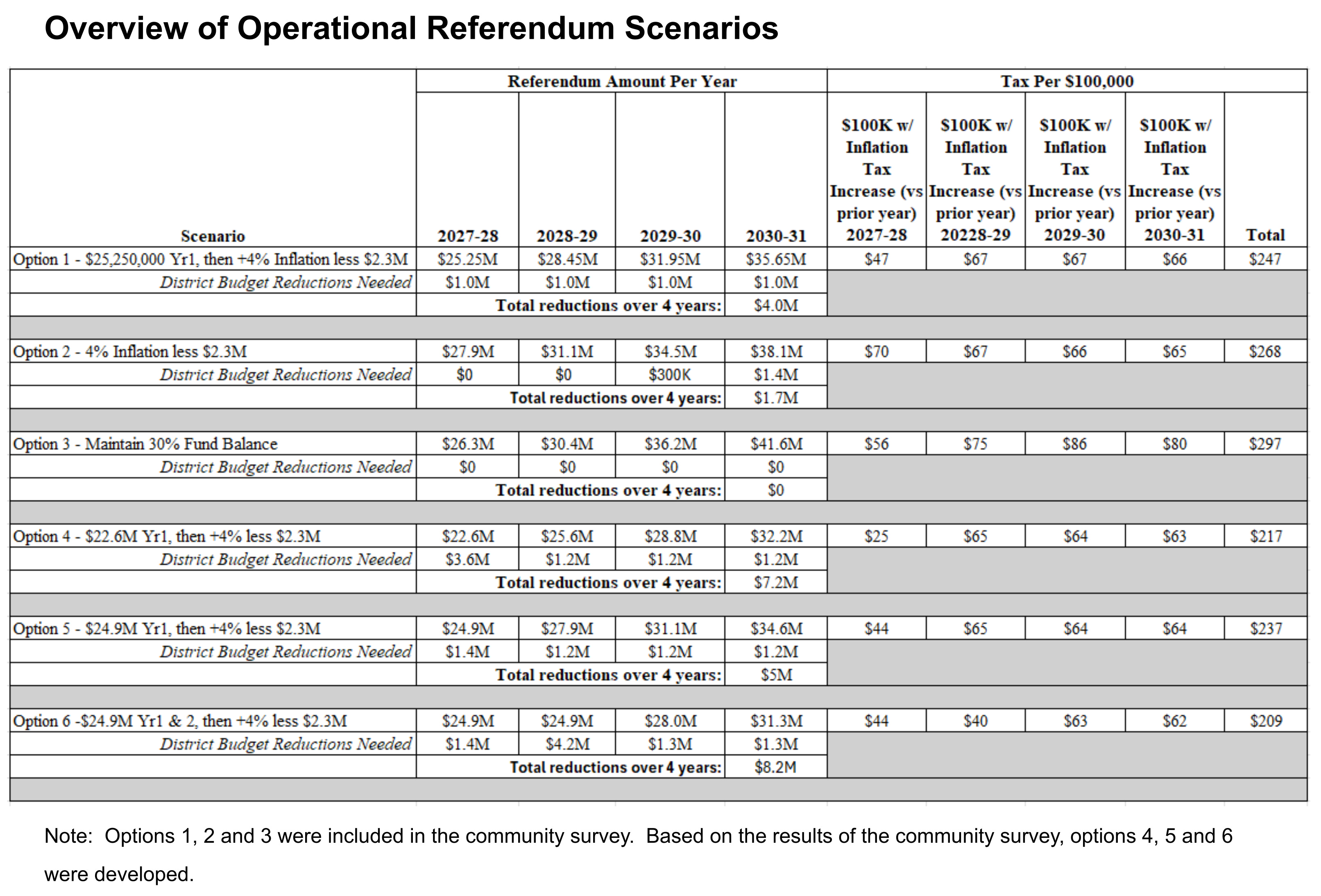
According to school district officials, these cuts would start at the district (administration) and work their way down to teaching staff, but they are confident that could achieve them without compromising the quality of education or levels of service. Which, of course, makes one wonder why these cuts haven’t been made earlier, and even why these monies were raised and spent in the first place, since they apparently fund programs and bureaucracy that are not essential to the school district’s educational mission..
Considering its voracious appetite for taxpayer dollars, the school district has to do a thorough job explaining what exactly it needs all that money for. Just citing inflation is not an explanation. It also wouldn’t hurt if the members of the school board actually asked tough questions. After all, they represent the interests of their constituents in front of the school district administration, and not the interests of the school district administration in front of their constituents.
The school board is expected to approve one of the three new options (4, 5 or 6 in the table) at its August 10 meeting.
Business
Glass Nickel Pizza in Middleton?
Rumor has it that Glass Nickel Pizza is opening a Middleton location in the former Dollar Tree space at Middleton Springs on Allen Boulevard. Assuming that the rumor is correct (and so far it has been neither confirmed nor denied), more details should follow in the foreseeable future.